Saturday, May 21, 2011

Cushing's FAQ

A FAQ (Frequently Asked Questions).  Directions are in each category for adding your own question.

IMPORTANT: The information and material posted on this Web site is intended as general reference information only. Specific facts and circumstances may alter the concepts and applications of materials and information described herein. The information provided is not a substitute for professional advice and should not be relied upon in the absence of such professional advice specific to whatever facts and circumstances are presented in any given situation.

Please note that there are several questions waiting to be answered at this time. Your question will be answered as soon as possible.

This is a different website than the message boards and requires a different log-in, although you may use the same log-in name and password.


Adrenal Insufficiency

Adrenal insufficiency is a life threatening chronic illness. An active and vigorous lifestyle with normal life expectancy is possible as long as the prescribed medications are taken regularly and adjusted when indicated. As with most chronic diseases, adrenal insufficiency demands that the patients take responsibility and develop self-management skills and techniques.

Read an article on Adrenal insufficiency

Cushing's Types

Cushing's Disease/ Cushing's Syndrome: Cushing's is a hormonal disorder caused by prolonged exposure of the body's tissues to high levels of the hormone cortisol. Your adrenal glands, which are right above your kidneys, release cortisol when they receive a chemical message from your pituitary gland. The message comes in the form of adrenocorticotrophic hormone (ACTH), which travels through the bloodstream.

Cushing's Disease Is the result of a pituitary tumor which causesthe emergence of secondary male characteristics (like hair growth, acne, etc.), and ovarian failure. Other symptoms usually include high blood pressure and water retention.

Cushing's Syndrome: Causes the same symptoms, but is a disorder marked by overproduction of adrenal hormones, which can cause a drop in LH and FSH.

An estimated 10 to 15 of every million people are affected each year. Cushing's is an increased concentration of glucocorticoid hormone (ACTH) in the bloodstream that is being produced by an adrenal gland tumor (adenoma). Ectopic Cushing syndrome refers to the production of ACTH in a location other than the pituitary gland or adrenalgland. Examples of ectopic sites include thymoma, medullary carcinoma of the thyroid, pheochromocytoma, islet cell tumors of the pancreas, and oat cell carcinoma of the lung.

Symptoms include weight gain, central obesity, moon face, weakness, fatigue, backache, headache, increased thirst, increased urination, impotence, mental status changes, and muscle atrophy.

Treatment varies with cause. If an ACTH secreting tumor is involved then it must be removed surgically.

More about Cushing's.

Talk about Cushing's with people who understand.

Subcategories:

Growth Hormone

Human Growth Hormone (hGH) is produced in the pituitary gland of humans, and the hormone is secreted throughout a person's lifetime. It promotes growth in children and plays an important role in adult metabolism.

More about HgH

Where Can I Find...?

Thursday, May 19, 2011

Another question for your responses...

Question #12: If you are a cycling Cushings, are there certain symptoms when your cortisol is high? Is there a way of knowing? it seems at night my chest has a flutter in it. also, I have been getting mild headaches. Thanks, Cherlyn

At http://www.cushie.info/index.php?option=com_content&view=article&id=393:discussiondebate-topics&catid=4:about-us&Itemid=79#comment-38

Wednesday, May 18, 2011

Can anyone help?

Does anyone know how to use this test? I have the saliva kit!!! four tubes... lab said there was instructions inside. yes! there is but, no time to do it. Is it a four day or three a day? Geesh! Does it have to be taken to the lab one day at a time so It is handled properly? Anyone? Thanks, Cherlyn

At http://www.cushie.info/index.php?option=com_content&view=article&id=393:discussiondebate-topics&catid=4:about-us&Itemid=79#comment-37

Can anyone on Facebook help?

what is the most successful with the least amount of risks and side affects. What is the easiest to live with for the rest of your life in trying to cure cushing's disease? Removal of an adenoma in my 7 year old son seems not to be successful, now we are trying to weigh our options to get him the cure that he needs, the cure that he deserves. They said we have 3 options....removal of the pituitary gland, removal of the adrenal glands, or radiation. I would like to know your first hand experiences and the pros and cons for everything.......

Please respond here or on Facebook

Tuesday, May 17, 2011

Helpful Hints for Dealing With Cushing's

Hint For... What to do

Add Your Helpful Hints for Dealing with Cushing's


Adrenal Crisis

On the Message Boards

Adrenal Crisis, getting medical attention

Before any crisis occures, contact the local ambulance service that would come to your home and/or work and find out if they have a protocol to treat you. My ambulance service could not give me the shot I needed even tho I not only had a medic alert bracelet, but a file of life on my refridgerator with physician instructions etc.

After my advent, we had to bring it to the governing body's attention for change, and now ambulance personel are approved to use information like the file of life or the Medic Alert bracelet to treat anyone with not only in Adrinal crisis but anyone with documented medical information.

You could help a lot of other people besides yourself. You may need the help of your physican.

Kim Pulsipher/Dr. Dan

Emergency Kit

Contact list: Primary and secondary.

Charged cell phone, all the time.

Directions for how to help. Print out info at http://www.cushings-help.com/911.htm

Medic alert bracelet or pendant. See what others have on theirs here.

Always carry a medical identification card that states the type of medication and the proper dose needed in case of an emergency.

Never omit medication. If unable to retain medication due to vomiting, notify the health care provider.

If there are places that you go often, be sure that those people know that you may have a problem. For a child, inform all of his/her teachers and other staff.


Body and Skin

On the Message Boards

Brown Spots

I have quite a few brown "age spots" on my face,  I accidentally discovered a way to camouflage them when I got a sample of Vaseline Healthy Body Glow. It "tans" your skin. In my case it made the skin dark enough to match the brown spots so they don't show up as much.

I've noticed that there are now lots of similar products on the market and I'm sure that they will all work as well.

~ MaryO


Bones and Muscles

On the Message Boards

Arthritis

Water aerobics for people with arthritis is really helping. I do that twice a week.

~ MaryO

Arthritis

Since I can't take my arthritis meds anymore, I've gone back on a combo pill of glucosamine/chondroitin. This only works for osteoarthritis, so if you have any rheumatoid, it won't work at all.

I was interested to see that The National Institutes of Health (NIH) is currently running a study of Glucosamine and Chondroitin Sulfate and Dr. Jason Theodosakis is heading this up.

There's more info on "Dr Theo" on Power Surge.

Dr Theo outlined the complete plan in his Power Surge transcripts, saying that it wasn't enough just to take the pills.

His plan is:

  1. Have a thorough consultation with a physician.

  2. Take glucosamine and chondroitin sulfates to repair damaged joints.

  3. Improve your biomechanics to counteract stress to your joints.

  4. Exercise regularly. (But the right kinds!)

  5. Eat a healthful, joint-preserving diet

  6. Maintain your ideal body weight.

  7. Fight depression.

  8. Use traditional medicine as necessary.

  9. Maintain a positive attitude.

~ MaryO

Arthritis

Question: Will the glucosamine/chondroitin that supposedly helps arthritis help with the pain and stiffness of steroid withdrawal? Is there any harm in trying it?

Answer: Glucosamine and chondroitin are chemical components of cartilage, tendons, ligaments, and other connective tissues that form the joints and muscle attachments. Some people with arthritic joint pain appear to benefit from taking these chemicals as dietary supplements (supplements because they are in a normal diet that contains meat). I am unaware of any report of their effect on the musculoskeletal symptoms of steroid withdrawal. However, I see no reason to anticipate any more risk for their use in this setting than in any other.

~ David Orth MD

Diet

Top 10 healthiest foods for spring

  1. Asparagus. Rich in vitamins A and C, calcium, iron and folate (the world's most common vitamin deficiency), asparagus has been prized for its culinary and medicinal purposes since ancient times.

  2. Green beans. Harvested while still immature when the inner bean is just beginning to form, they are one of the few bean varieties that can be eaten fresh..

  3. Spring Chinook salmon. The health benefits of eating fatty, cold-water fish are widely known, but salmon contains the highest volume of omega-3 fatty acids, essential for maintaining good heart health.

  4. Spinach. A Mediterranean favorite since the 16th century, spinach is a rich source of vitamin A (for cardiovascular health) and vitamin K (for bone health).

  5. Apricots. The true fruits of spring, apricots were first discovered in China and have been cultivated for more than 3,000 to 4,000 years. They are also rich with beta-carotene and lycopene, two carotenoids important in reducing the artery-clogging LDL cholesterol and maintain a healthy heart.

  6. Spring onions. Onions have been the subject of new research linking them to lower incidence of certain cancers. They also provide vitamins A and C, calcium and iron.

  7. Green peas. Green peas are a rich source of folate and a wide range of B vitamins, essential for the proper metabolism of fats, proteins and carbohydrates.

  8. Basil. A popular herb that can enhance the flavors of your favorite pasta sauce or spring salad, basil is a wonderful source of vitamin A.

  9. Avocados. Previously avoided by dieters due to their high fat content, avocados have made a comeback as a great source of heart-healthy monounsaturated fats to help lower cholesterol. By volume, avocados are also 50 percent higher in potassium than bananas.

  10. Spring greens. Choose from arugula, romaine, mesclun, bok choy and watercress to mustard, collard and dandelion greens. All are rich in lutein, beta-carotene, vitamin C, folate, minerals and fiber and excellent for digestion.

~ msn.com

Diet

Nutrition for Patients with Cushing Syndrome (National Institutes of Health, Clinical Center) - PDF File

~ NIH, National Institutes of Health, Clinical Center

Diet / Exercise

Question: While my cortisol levels are still high, is there anything I can do with my diet or exercise to keep my weight from increasing and loosing more strength? Is protein intake important?

Answer: With excessive cortisol levels, diet and exercise are important to keep from gaining weight and losing more muscle strength. A nutritious diet with a multivitamin supplement is recommended, usually the diet should not exceed 1000 to 1200 calories per day. It is important that the balanced diet contain adequate protein, however excessive protein intake probably will not make much difference in muscle strength since excessive cortisol causes protein (muscle) breakdown. Since patients are usually treated soon after diagnosis, no studies have evaluated the effect of a high protein diet.

Regarding exercise, the best type of exercise is that which is not stressful to the skeletal system. For example, swimming and bicycle riding are good exercises. Jogging and lifting weights are probably not a good idea since this does place stress on the skeleton (bones). Additionally, a calcium supplement is important. The recommended amount of approximately 1500 mg of elemental calcium per day can be achieved by taking 4 Tums Ultra or 3 tablets OsCal 500.

~ Mary Lee Vance MD

Headache

I choose to just eat salt like it's a candy. I have a little container of plain sea salt (you don't want the iodized stuff) and I lick my finger and just dip it! Gross I know... but it's cured many a headache. My sodium remains low... but it never ceases to amaze me how salt will taste good, and then just stop tasting good. That's how i know I've had enough.

~ ADDflower

Muscles

Question: My Cushing's has been cured for about 3 years, but my muscle strength is still not like it used to be. I work out at a gym regularly, but is there anything else that I can do to try and recover my strength?

Answer: Deterioration of muscle function is a common consequence of Cushing's syndrome. The majority of patients recover full muscle strength and performance after cure of their Cushing's syndrome. Physical therapy and a high protein diet have both been shown to improve muscle strength in patients with steroid-induced muscle damage. After cure, most patients recover normal muscle strength within 1-2 years.

~ James Findling MD

Muscle fatigue and weakness

From the message boards

Question: A really big problem for me (and seems like a lot of people) is the muscle weakness and fatigue. Does anyone have any tricks that work for them?

Answer: One thing that has helped me is eating more salt. Of course if your blood pressure is really high already, you shouldn't do this. But mine runs pretty low and I have a hard time keeping my liquids....I am in the bathroom constantly. This is something Dr. F recommended after finding that I have low aldosterone and renin. Also, I am taking vitamins and iron. It seems to help sometimes and sometimes I am as fatigued as can be, but I figure it can't hurt. Hope this helps!

~ Mertie

Answer: If you are cyclical, it is SUPER important to chart. Part of the problem is that for some folks a Low symptom is another person's High. After awhile you should be able to see a pattern showing itself.

And yes, when I'm low like that, I did eat salt out of the shaker (I even have 5 different flavored salts, I know, i'm a whacko!)

But when I'm in a Low, I haven't found a way to pop out of it, or force a High. It's something I'm working on though.

....If I eat lots of pasta or bread, I have lots of muscle aches and pains. A big bowl of mac'n'cheese will make me feel like I'm having a fibro flair most days

~ vinesqueen

Answer: You're right. I choose to just eat salt like it's a candy. I have a little container of plain sea salt (you don't want the iodized stuff) and I lick my finger and just dip it! Gross I know... but it's cured many a headache. My sodium remains low... but it never ceases to amaze me how salt will taste good, and then just stop tasting good. That's how i know I've had enough.

~ ADDflower

Answer: One thing to try to find is Sea Salt to replace your normal salt with in the house. It is better for you than regular table salt.

I crave salt and sugar. I can't get enough of either one.

I need to pick up some DHEA and try it out, it is a precursor hormone and I hear people say it help them feel better.

I can't seem to find any way to feel better lately, so I am working on a strategy also. I'm back to taking Flintstones vitamins with Iron and an extra Vitamin B6 also.

~ LisaMK

Add your suggestion on the message boards

Osteoporosis

Question: I have osteoporosis due to Cushing's. Will this improve over time?

Answer: A recent study has shown substantial improvements in bone density within several years after the successful cure of patients with pituitary Cushing's. Bones have the best possible chance for recovery when the replacement steroid dosage is as low as possible. If you are on replacement therapy following surgery, you should be working with your doctor to taper the steroid dose at a rapid , but tolerable rate.

Bones can also benefit from a healthy diet and intake of at least 1 gram of calcium per day. Exercise has also been shown to be beneficial, but is best started under the supervision of a physician. Most patients with osteoporosis can undertake exercise such as walking or swimming without risk of injury. Exercise that is weight bearing, such as weight lifting, or exercise that involves a risk of falling, such as skiing, would not be advisable unless under the direction of a physician or physical therapist.

~ David Orth MD

Swelling

Question: Following surgery for Cushing's, I have had a lot of swelling in my hands, feet and face. Is there anything that can be done to help this problem and is it anything to be concerned about?

Answer: Swelling, or edema, may often accompany Cushing's syndrome. Following surgical treatment of Cushing's, some patients will continue to experience edema for some time following the surgery. This may be related to the frequent need for steroid therapy following curative surgery. This is really nothing serious, but can be uncomfortable. I usually treat patients with a water pill or decrease the dose of steroids.

~ James Findling MD


Eyes, Ears, Nose,
Sinus, Throat

On the Message Boards


Hair

On the Message Boards


Heart and blood

On the Message Boards


Psychological

On the Message Boards


Sleep and Fatigue

On the Message Boards


For insomnia try Bach Rescue Sleep. Two sprays on the tongue really seem to help. It is available in most health type stores and markets.


Miscellaneous

On the Message Boards


ALWAYS TRUST YOUR INSTINCTS!!

Read ~ Susan's bio


What pointed me in the cushing's disease direction were the symptoms such as buffalo hump; hair growth on specific areas; weight gain around my neck, face, abdomen, chest and back; my pituitary adenoma and the last results from my test that showed high levels of cortisol.

Read ~ Gina's bio


Get a copy of ALL your lab test results and copies of imaging reports and the actual images....on CD and films.

Read ~ Gina's bio


It is absolutely critical for your physical and emotional health for you to have a doctor with expertise and experience with Cushing's! Inexperienced doctors all too often misdiagnose, insult and frustrate, preventing prompt and proper diagnosis. Misdiagnosis can be lethal!

Obviously, it is also crucial for you to have a surgeon with experience in order to minimize the likelihood of errors that can lead to complications or death. Wouldn't you prefer someone who performs the surgery 5 days per week over someone who may have done it a total of 5 times in his or her career?

On the other hand, doctors with experience are most likely to be more thorough and precise in recommending and offering the proper tests and treatments, and more aware of the subtle nuances and possible complications of the syndrome, learning from each Cushing's patient s/he treats, to the benefit of others.

Investigate your insurance, and if necessary (and possible), change your coverage in order to be able to afford to go to doctors who are Cushing's experts. Because Cushing's is often caused by a tumor, some insurance (including United Health Care) covers Cushing's related medical expenses including travel to facilities they consider "cancer centers for excellence" if you need to travel over 100 miles to these experts. United Health Care covers medical expenses with no co-pay, including travel, lodging and meals for myself and a travel companion so that I am able to afford the best medical care possible from doctors who are experienced with Cushing's.

~ Judi


The most important advice I have to give is this:

1) GO TO A TEACHING/RESEARCH HOSPITAL!!!

2) If you have kids, think twice before eating disorder treatment. I went into the program with pain and a method of coping. I came out with an eating disorder psyche, bad experiences, and a truckload of pills that were making me crazy.

3) IF YOU THINK YOU HAVE FOOD DEPENDANT CUSHINGS, HERE IS HOW I COPE;

• the cortisol goes up with too much of any protein, fat or carbs. I eat small turkey/cheese sandwiches at every meal (enough to be full, but well balanced).

• I use stevia instead of sugar because its natural (health food aisle.)

• alcohol really hurts now, so only a little wine occassionally.

• lots of yogurts.

• every couple days a mixture of senna laxative and stool softener (not too often)

4) Remember the squeekiest wheel gets the grease.

~ Magdalena's bio


Men

On the Message Boards

Sex Drive

Question: Since having Cushing's, my sex drive is next to nothing. Is this common, will this problem remain forever or get better? Is there anything that can help?

Answer: A decrease in libido or sex drive is common in patients with Cushing's. Several factors influence a person's sex drive.

In women, regular menstrual periods or adequate estrogen and progesterone replacement is important.

In men, if the testosterone level is low, this indicates the need for testosterone replacement. In pituitary dependent Cushing's, once the normal pituitary gland has recovered, the adrenal glands should be producing an adequate amount of both cortisol and male hormones (important in women for sex drive).

If a woman has had 1 adrenal gland removed, the other adrenal should make an adequate amount of male hormones once the entire pituitary adrenal axis has recovered (this may take several months as well). In the situation of bilateral adrenalectomy, there is loss of adrenal male hormone production. If the ovaries are functioning normally, male hormones are also produced and this should provide an adequate amount for normal libido.

If a woman does not have normal menstrual function and requires estrogen and progesterone replacement, sometimes a small dose of testosterone is added to improve libido. A common preparation is Estratest.

~ Mary Lee Vance MD


Women

On the Message Boards

Sex Drive

Question: Since having Cushing's, my sex drive is next to nothing. Is this common, will this problem remain forever or get better? Is there anything that can help?

Answer: A decrease in libido or sex drive is common in patients with Cushing's. Several factors influence a person's sex drive.

In women, regular menstrual periods or adequate estrogen and progesterone replacement is important.

In men, if the testosterone level is low, this indicates the need for testosterone replacement. In pituitary dependent Cushing's, once the normal pituitary gland has recovered, the adrenal glands should be producing an adequate amount of both cortisol and male hormones (important in women for sex drive).

If a woman has had 1 adrenal gland removed, the other adrenal should make an adequate amount of male hormones once the entire pituitary adrenal axis has recovered (this may take several months as well). In the situation of bilateral adrenalectomy, there is loss of adrenal male hormone production. If the ovaries are functioning normally, male hormones are also produced and this should provide an adequate amount for normal libido.

If a woman does not have normal menstrual function and requires estrogen and progesterone replacement, sometimes a small dose of testosterone is added to improve libido. A common preparation is Estratest.

~ Mary Lee Vance MD


Children

On the Message Boards

Help Yourself


Sunday, May 15, 2011

Cushing's caused by stress

Cynthia asks at Discussion/Debates topics:


Can Cushings be caused by stress alone? Can stress elevate cortisol levels for many years at a time? When stress levels improve, do the physical symptoms decrease? I have a family member who has had high stress for approximately ten years and I see some of these symptoms. However, I have also recently seen what appears to be some improvements.

Tuesday, May 10, 2011

Explaining Cushing's to Others

Kate on the Cushing’s support board (Cushing’s Help and Support) wrote this letter after having pituitary surgery…

Dear friends and family:

I am writing this letter to share with you some basic facts about Cushing’s Disease/Syndrome and the recovery process so that you will have sufficient information to form realistic expectations about me and my ability to engage in certain activities in light of this disease and its aftermath.

As you know, Cushing’s is a rarely diagnosed endocrine disorder characterized by hypercortisolism. Cortisol is a hormone produced by the adrenal glands and is vital to regulate the body’s cardivoascular functions and metabolism, to boost the immune system and to fight inflammation. But its most important job is to help the body to respond to stress.

The adrenal glands release cortisol in response to stress, so atheletes, women experiencing pregnancy, and those suffering from alcoholism, panic disorders and malnutrition naturally have higher-than-normal levels of cortisol.

People with Cushing’s Syndrome live life with too much cortisol for their bodies as a result of a hormone-secreting tumor. Mine is located in the pituitary gland. Endogenous hypercortisolism leaves the body in a constant state of “fight or flight,” which ravages the body and tears down the body’s major systems including cardivascular, musculo-skeletal, endocrine, etc.

Symptoms vary, but the most common symptoms include rapid, unexplained weight gain in the upper body with increased fat around the neck and face (“moon facies”); buffalo hump; facial flushing/plethora; muscle wasting in the arms and legs; purplish striae (stretch marks) on the abdomen, thighs, buttocks, arms and breasts; poor wound healing and bruising; severe fatigue; depression, anxiety disorders and emotional lability; cognitive difficulties; sleep disorders due to abnormally high nighttime cortisol production; high blood pressure and high blood sugar/diabetes; edema; vision problems; premature osteoperosis; and, in women, signs of hyperandrogenism such as menstrual irregularities, infertility, hirsutism, male-patterned balding and steroid-induced acne.
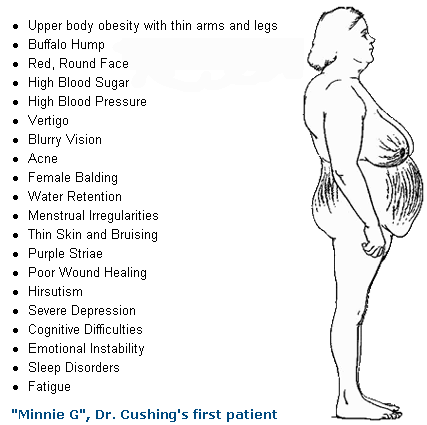
Cushing's Symptoms


Attached, you will find a sketch of a typical Cushing’s patient. As you can see, the effects of the disease on the body are dramatic.

Worse, the psychological and emotional effects of having a chronic, debilitating and disfiguring disease range from distressing to demoralizing.

Imagine that, in the space of a year, you became unrecognizable to those around you and to yourself. You look in the mirror, but the person staring back a tyou is a stranger. You endure the stares and looks of pity from those who knew you before Cushing’s, fully aware that they believe you have “let yourself go” or otherwise allowed this to happen to your body. Nothing you can say or do will persuade them otherwise, so at some point, you stop trying and resolve to live your life in a stranger’s body.

You feel increasingly sick, but when you explain your array of symptoms to your doctor, you are dismissed as a depressed hypochondriac who needs to diet and exercise more. Worse, your family members think the same thing — and are often quick to tell you how you need to “change your lifestyle” to overcome the effects of what you eventually will discover, once properly diagnosed, is a serious and rare disease.

If only it were so simple! No one would choose to have Cushing’s. Those of us who have it would not wish it even on our worst enemy.

Most people with Cushing’s long for the ability to do simple things, like walk a flight of stairs without having to sit for half an hour afterwards, or vacuum the house or even unload a dishwasher.

One of the worst parts about this disease is the crushing fatigue and muscle wasting/weakness, which accompanies hypercortisolism. Not only do we become socially isolated because of the virilzing effects of an endocrine tumor, which drastically alters our appearance, but we no longer feel like ourselves with regard to energy. We would love to take a long bike ride, run three miles or go shopping like we used to — activities, which we took for granted before the disease struck. Those activities are sadly impossible at times for those with advanced stages of the disease.

Sometimes, as with any serious illness, performing even basic tasks of daily care such as showering and dressing can exhaust the limited reserves of energy available to a Cushing’s patient.

How do we explain to you what it’s like to watch our lives slip away? What response is sufficient to express the grief and frustration over losing so much of ourselves? It is often difficult to find the strength to explain how your well-meaning words of prompting and encouragement (to diet or exercise) only serve to leave us more isolated and feeling alone.

Though we wouldn’t want it, we wish our disease were as well-understood as cancer so that those who love us would have a frame of reference for what we go through. With Cushing’s, there is such limited public awareness that we are left to describe the effects of the disease from a void, often with limited understanding from those who love us most, which is disheartening.

The most frustrating misconception about this disease is that we somehow are “doing this to ourselves,” or delaying recovery because we need to continue steroid replacement or lack the energy to excercise often, which is sadly false. Trust me that we would love to have that much control over such a terrible disease.

Fortunately, there is a good likelihood of remission from Cushing’s in the hands of a skilled pituitary surgeon. Unfortunately, the long-term remission rate is only 56%, meaning that 44% of people with Cushing’s will require a second (sometimes third) pituitary surgery, radiation or bilateraly adrenalectomy to resolve the hypercortisolism. Without successful treatment, Cushing’s leads to death. Even with successful treatment, I will have to be monitored for possible recurrence for the rest of my life.

After surgery or other treatment, the recovery period can last months or even years. Because the tumor takes over control of the body’s production of cortisol, the adrenal glands, which had lain dormant prior to surgery, require time to start functioning properly again.

Until this happens, we must take synthetic steroids or else risk adrenal insufficiency or adrenal crisis, which can be quickly life-threatening. Careful monitoring of our cortisol levels is critical during the weaning period. It is a rare but sad fact that some people’s adrenal glands never return to normal, and those people must continue to take hydrocortisone or prednisone — sometimes for life — simply in order for the body to perform correctly its basic systemic functions.

The physical recovery from surgery can be quick, but the withdrawal from hydrocortisone can be a lengthy and extremely painful process. As I described above, Cushing’s causes a tearing-down of muscles and bone. While there is an over-abundance of cortisol in our bodies (as a result of the tumor), we often can’t feel the effects of the muscle-wasting and bone deterioration because of the anti-inflammatory action of cortisol. Upon weaning, however, these become painfully (literally!) evident.

The physical pain experienced while weaning from cortisol has been described as worse than weaning from heroin. When cortisol levels are low, one experiences the symptoms akin to a really bad flu, including severe fatigue (”like a wet cement blanket laid on top of me”); weakness and exhaustion; nausea; headache; vomiting; mental confusion. It is imperative for people who are on replacement steroids after Cushing’s surgery to carry extra Cortef (or injectable Solu-Cortef) with them at all times in addition to wearing a medic alert bracelet so that medical professionals will be alerted to the possiblity of adrenal insufficiency in the event of an adrenal crisis.

People who have struggled with Cushing’s Syndrome all hope to return to “normal” at some point. Though none of us want to have Cushing’s, it is often a relief finally to have a correct diagnosis and treatment plan. For many, there is a gradual resolution of many Cushing’s symptoms within a few years of surgery or other successful treatment, and a good quality of life can be achieved.

But regrettably, this is not possible in every case. Depending on the severity of the disease and the length of time before diagnosis and treatment, the prognosis can be poor and lead to shortened life expectancy and diminished quality of life. This is not a choice or something we can control, but it is the reality for some people who have suffered the consequences of long-term hypercortisolism.

The best support you can give someone who is suffering from Cushing’s or its aftermath is to BELIEVE them and to understand that they are not manufacturing their illness or prolonging recovery. Ask them what they are able (and not able) to do, and then be prepared to help them in ways that matter — whether that be to bring them a meal or help them to run errands, pick up prescriptions from the pharmacy or clean their house.

Because it’s these little everyday tasks, which can fall by the wayside when someone has (or has had) Cushing’s, and these are the things we miss the most: doing for ourselves.

Ask us questions about the disease, and then actively listen to what we say. We know you don’t know much about Cushing’s — even our doctors sometimes lack information about this rare disease. But know we appreciate the interest and will tell you everything you want to know, because those of us who have it necessarily become experts in it just in order to survive.

Thank you for caring about me and for hearing what I am saying in this letter. I know you love me and are concerned about me, and I appreciate that so much. Thank you also for taking the time to read this letter. I look forward to discussing further any questions you might have.

In the meantime, I am attaching a brief article written by a woman who recently was diagnosed with Cushing’s. I hope hearing another person’s experiences will help you to understand what I’m going through so that when we talk, we will be coming from a similar starting place.


Endocrinologists (doctors who specialize in Cushing's Syndrome and its related issues) realize the medical aspect and know the damaging effects that Cushing's has on the body. Family and friends see their Cushie suffering and know they are hurting physically and often times mentally and emotionally. However, understanding the debilitation of Cushing's and how it can affect every aspect of a person's life can only be truly realized by those who have experienced the syndrome.

Cushings Help Organization, Inc., a non-profit family of websites maintained by MaryO, a pituitary Cushing's survivor, provides this letter for patients to provide to their family and friends in hopes of providing a better understanding Cushing's and it's many aspects.

We're sorry to hear that your family member or friend has Cushing's Syndrome or suspected Cushing's. A person may feel better at times then at other times. It's common for a Cushing's patient to have burst of energy and then all of a sudden they become lethargic and don't feel like moving a muscle. There are many symptoms that are associated with Cushing's. They include weight gain, fatigue, muscle weakness, shortness of breath, feeling achy all over, headaches, blurred vision, mood swings, high blood pressure, stretch marks (straie), buffalo hump, diabetes, edema and the list goes on. Hormones affect every area of the body.

It is important to note that not all patients have every symptom. Even some hallmark symptoms, such as straie or the "buffalo hump", may not be noticable on every patient. Not everyone who has Cushing's will experience the same symptoms, treatment, or recovery. Because not all "Cushies" have these symptoms, it makes diagnosis even more difficult.

Cushing's can cause the physical appearance change due to weight gain, hair loss, rosacea, acne, etc. This can be very disturbing when looking in the mirror. Changes in appearance can often cause the Cushing's patient to withdraw from family and friends making it a very lonely illness. Patients often feel alone or withdrawn because few others understand.

Cushing's can affect affect anyone of any age although it is more commen in women.

Cushing's patients need to be able to take one day at time and learn to listen to their bodies. There will most likely be times when naps are needed during the day and often times may not be able to sleep at night due to surges of cortisol. Your Cushie doesn't expect you to understand Cushing's Syndrome completely. They do need you to be there for them and try to understand to the best of your ability what they feel and not give up on them.

Often a Cushing's patient may be moody and say things that they don't mean. If this should happen with your Cushie try not to take it personally and know that it's most likely caused by the elevated cortisol and disturbances in other hormone levels caused by the Cushing's and not from the heart or true feelings of your Cushie.

It can be very depressing and frustrating having so many limitations and experience things in life being taken from you. Cushing's patients are sick, not lazy, not hypochondriacs or even the newer term "Cyberchondriacs". If a Cushing's patient says they don't feel like doing something or they express how bad they feel let them know that you believe them. One of the most frustrating things to someone who is sick is to have those you love not believe you or support you. Telling a Cushie to think positive thoughts will not make him/her well and will just be aggrivating.

Testing procedures can be lengthy and this can become frustrating for the patient and family. Often, it takes a while for results to come back and this can be stressful. Don't look to far ahead just take one day at a time and deal with the situation that is at hand at the present time.

After a diagnosis is made then it's time for treatment. Surgery is usually the best treatment option for Cushing's that is caused by tumors. Don't be surprised if the surgeon's facility wants to run even more tests or redo some of those that have already been done. Your Cushie may have to travel a ways to find a surgeon who is trained in these delicate surgeries and who has performed many of them.

Once the diagnosis has been made and treatment has finished then it's time for the recovery process. Not all patients who have surgery are cured and they have to make a choice along with the advice of their doctor as to what their next treatment option will be.

The recovery from the surgery itself is similar to any other surgery and will take a while to recover. The recovery process obtained from getting a cure from Cushing's is quiet different from other surgeries. A Cushing's patients body has been exposed to excess cortisol, usually for quite a long time, and has become accustomed it. When the tumor is removed that has been responsible for the excessive cortisol and the body is no longer getting it this causes the body to have withdrawal symptoms. Withdrawal can be very hard causing an array of symptoms muscle aches, weakness, bone and joint pain, emotional disturbances etc.

Thank you for reading this and we hope it will help you to understand a little more about Cushing's and the dibilating affect it can have on a person. Thank you for being there and supporting your Cushie during this time in their life. We realize that when a family member has Cushing's it not only affects the individual but other family members and those around them as well. Showing your love and support will encourage a speedy recovery for your Cushie.


‘The ugly disease’

By Toby Hatchett features@seacoastonline.com This e-mail address is being protected from spambots. You need JavaScript enabled to view it

When Fedela Vincent, 68, of Rye, was diagnosed with Cushing’s disease, she was relieved, almost happy. After more than three years, she knew what was wrong with her.

Vincent had spent years trying to figure out what was wrong with her, what was happening to her and her body. A petite woman, of 5 feet, she had always been trim and fit. She ate right, worked out at the gym and led a healthy lifestyle.

But, for no apparent reason, she began to gain weight. Lots of weight, primarily in the upper body.

“I looked like an apple, with a moon face,” Fedela says. “Cushing’s is not called ?the ugly disease’ for nothing.”

Cushing’s disease victims don’t share the same symptoms, but many of the symptoms are physically noticeable: the extreme weight gain in the upper body, the moon face, a buffalo hump on the back, hair loss and blotchy, red skin with breakouts.

“Feeling constantly cruddy” is the polite description of being a Cushie,” Fedela says.

Then there are the other symptoms, those not visible on the outside. Fedela says the worst for her was the insomnia, the anxiety, the fear of abandonment and pain. The joints hurt, the muscles lose their mass and walking is difficult.

When Fedela was at her worst, she couldn’t walk up the stairs, let alone cook or shop. She was as weak as a kitten, she says.

Her doctors at this time urged her to lose weight, giving medications that often made her sick in an effort to solve the problem.

Bob Vincent, her husband of 48 years, never left her side during this difficult time. Cushing’s disease is such a traumatic disease that it is estimated more than half of husbands leave their wives. The mood swings can be dramatic.

“When Bob would bring me coffee,” says Fedela, “he never knew what to expect.”

Then Fedela decided to try a different kind of doctor. She went to Dr. Jennifer Warren, in Hampton, who specializes in weight control. In Warren, she found someone who listened to her and paid attention. Warren was the first doctor to suggest Cushing’s disease might be the cause of Fedela’s weight gain.

From that moment on, things began to happen. Fedela went to Dr. Daniel Nadeau who put her on a diabetes-related medication for weight loss. This didn’t work and after a month, she was given a simple urinalysis test. Within 24 hours, she had her diagnosis.

Nadeau referred Fedela to the Lahey Clinic, in Burlington, Mass. There she met the doctor she now calls her “savior,” Dr. Nicholas Tritos. This clinic is world-renowned for its work in pituitary malfunctions.

What is Cushing’s disease? It is the body reacting to a constant overdose of steroids being released by the adrenal glands. The pituitary gland over-stimulates the adrenal glands, which in turn send crisis-level chemical messages to all the other endocrine glands.

“The body reacts to the hyper-stimulation by constantly being in a state of fight or flight,” says Fedela. “It’s 24/7 with no relief.”

Cushing’s disease affects an estimated 10 to 15 out of every million people. The fact that it is relatively rare in numbers is one cause of the lack of public knowledge and awareness of this disease.

Non-diagnosed, Cushing’s disease can lead to uncontrollable diabetes, and eventually, death. The symptoms can be so varied and mimic so many other conditions, that Cushing’s disease is often not diagnosed or misdiagnosed.

“The not knowing what is wrong with you is awful,” Fedela says, “and the way people look at you when you’re not what society calls "normal.’”

“People would tell me ?you are what you eat’ and suggest I try Weight Watchers, things like that.”

But Fedela was carefully watching what she ate, often eating less than her doctors prescribed. Even when her energy level was almost non-existent, she and her husband would go to the gym.

“Bob wouldn’t let me stay inside. We kept going out, for drives, to Market Square and lunch with friends.”

After the initial diagnosis, Fedela spent six months undergoing various tests.

Then, on Mother’s Day of this year, during the New Hampshire floods, she was operated on. Fifty percent of one side of the pituitary was removed and 25 percent of the other side to remove the offending tumorous tissues.

Fedela spent five days recovering at the Lahey Clinic.

“The whole staff was just wonderful. The nurses would pop in to see what a Cushie looked like. They never left me alone.”

When she came out of the surgery, Bob was there beside her, along with a very special teddy bear.

“The teddy bear was hugged by members of South Church, including the children Fedela taught in her kindergarten class,” he said.

The blessing of this disease, as Fedela describes it, is in learning how to receive. Having long been a giver herself, this was not an easy lesson to learn. South Church, in Portsmouth, put together a Fedela Vincent Support Group, with people from Portsmouth, Rye, Salem, Mass., and Greenland, to provide moral support, company and meals. For six weeks, day and night, someone was there.

“South Church is an amazing institution,” Bob says. “The support group was invaluable. Fedela received over 250 cards from all over the country.”

This support group is still there for Vincent as she continues to recover and regain her health. She still has problems, but she can now lead a more normal life. “I can shop!” she says with a grin.

“I wanted to do this interview as a call to the medical community to be alert to the symptoms of Cushing’s disease and to really listen to their patients.”

Fedela also hopes that by sharing her story, others may learn that diet alone is not always the cause of weight gain. America’s obsession with skinny bodies and the resulting negative judgmental views on those who do not fit this picture is something she hopes people may think twice about before making judgments.

Lastly, Fedela wants to publicly thank her husband, family, friends and physicians who have stood by her during this difficult struggle. She still has a long way to go, but she is on the mend now and knows what was wrong with her.

“The not knowing what was happening to me was the worst of all.”

“If by telling my story, I can help even one person not go through what I did, then it’s worth it.”

Tritos, a leading endocrinologist at the Lahey Clinic, says it is common for Cushing’s disease to not be immediately diagnosed.

“It is common because the condition itself is uncommon. The symptoms are subtle and can be attributed to other causes.”

“In Fedela’s case, her own body was producing an overload of steroids.”

There is a peculiar type of weight gain, in the face, neck and upper torso. Unfortunately, it can take awhile to be diagnosed.

“Most patients go from one doctor to another before Cushing’s disease is diagnosed.”

Also, Tritos says, sometimes the tests are inconclusive.

But once on the appropriate path, most patients can be helped.

Tritos also notes the value of a good support system, which Fedela had in place.

“The support of family and friends is very important. By telling her story, Mrs. Vincent will increase the public’s awareness of Cushing’s disease.”

Tuesday, May 3, 2011

Can You Help Franski with His Questions about Mitotane?

Franski asks:

What can they do if you have no tumors but you are still pumping large amounts of cortisol and all the symptoms? i was diagnosed years ago but did not get treated and now it's gotten a lot worse but the doctors where i live are baffled because there are no tumors.They have mentioned Mitotane therapy? anyone have this before?


He asked this question here: http://www.cushie.info/index.php?option=com_content&view=article&id=1:welcome&catid=1:cushings

The CushieWiki is back!

The CushieWiki could use YOUR input.  Please help us with this body of Cushing's knowledge: http://www.CushieWiki.com

Contributors can add and edit information to be sure that we have the most current knowledge available.

Members of the Cushings-Help message boards - please sign up with the same user name on the boards.

After you've logged in, you may create or edit any pages except for the home page.  If you wish to make changes to that, please email MaryO and let her know what you'd like added/removed/changed.

To start a new page, simply search for it.  If it doesn't exist yet, you have the ability to add it from there.  The Help/Practice page is here.

Friday, April 22, 2011

Can You Help LeAnna and her son?

LeAnna writes: My 7 year old is going in for his transphenoidal pituitary surgery in less than 10 days. I am so worried. anyone know what to expect? we will be out of town for this surgery and they said its about a week hospital stay. I just want him cured and to heal quickly. He has high spirits and he keeps me strong. But, how do I help him through something like this?
On FaceBook at https://www.facebook.com/permalink.php?story_fbid=10150169902158954&id=286088733953
Thanks!

Thursday, April 21, 2011

Can You Help Franski with His Questions?

He wrote:
#4 franski 2011-04-20 11:47
Would also love some info on the drug Miototane?


#3 franski 2011-04-20 11:47
could use a lil help folks.Live in the wilds of N.Y state and can't seem to get treatment for my cushings.I'm lost with this and at the end of my rope.My doctor has confirmed the disease but has also told me he really doesn't know much about it.and the one endo who does is not taking new patients.wth!

Please respond here or on his original questions at http://cushie.info/index.php?option=com_content&view=article&id=393:discussiondebate-topics&catid=4:about-us&Itemid=79#comment-24

Thanks!

Saturday, April 16, 2011

Can anyone help Karen with Cyclical Cushing's?

Has anyone had experience with or know about Cyclical Cushing's? I am at a peak of frustration because I have had to get labs done over and over again with varying cortisol level results. I am eager to move on to treatment and feel that this is holding me back or that the medical field knows little about the possibility of cortisol cycles. I am desperate to hear about any experiences with this....

Please reply at https://www.facebook.com/permalink.php?story_fbid=10150164376813954&id=286088733953

Friday, April 15, 2011

Can You Help Nina with Cushing's and ADHD?

Nina writes: I was diagnosed with Cushing's in March of 2008. Doctor's removed a tumor and my right adrenal gland. I'm no longer on steriods. Feel much better however I think I might have adhd. Has anyone who has had Cushing's had ADHD? I'm a 55 year old female. Any import or comments would be appreciated. Thank you.

Reply at http://cushie.info/index.php?option=com_content&view=article&id=238:dr-robert-lamberts-popular-doctorblogger&catid=34:interview-archives&Itemid=70#comment-22

Tuesday, April 12, 2011

Can anyone help Kim with a diagnosis?

Can you help this person who is discouraged getting a diagnosis? http://www.empowher....e#comment-83435

My name is Kim an I am 32yrs. old, I am currently being tested for Cushings Syndrome. I am experiencing all symptoms from weight-gain, buffalo hump, thinning limbs,moon-face, you name it. I am very depressed an spend most of my time at home due to my physical features which kills my self-esteem. Reading similar story's of what I'm going through has help me to better understand what to expect with this syndrome. I many questions, if anyone could help me, I would appreciate the support.
Kim S.

~~~~

Today I went to PCP and my results from urine was 17, she said it was too low. She doesn't feel like there is anything wrong with me. But, things seem to be getting worst swelling on my right side which really hurts. Headaches, limbs are thinning fast with ugly purple marks.What do I do now??Please help???

Sunday, April 10, 2011

Pituitary hyperplasia secondary to acquired hypothyroidism: case report

Roberto Franceschi email, Umberto Rozzanigo email, Riccarda Failo email, Maria Bellizzi email and Annunziata Di palma email

Italian Journal of Pediatrics 2011, 37:15doi:10.1186/1824-7288-37-15

Published: 7 April 2011

Abstract (provisional)

Objective and Importance: despite recent progress in imaging, it is still difficult to distinguish between pituitary adenoma and hyperplasia, even using Magnetic Resonance Imaging (MRI) with gadolinium injection. We describe an example of reactive pituitary hyperplasia from primary hypothyroidism that mimicked a pituitary macroadenoma in a child.

Clinical Presentation: a 10 year old boy presented with headache and statural growth arrest. MRI revealed an intrasellar and suprasellar pituitary mass. Endocrine evaluation revealed primary hypothyroidism.

Intervention: the patient was started on levothyroxine with resolution of the mass effect.

Conclusion: primary hypothyroidism should be considered in the differential diagnosis of solid mass lesions of the pituitary gland. Examination of thyroid function in patients with sellar and suprasellar masses revealed by MRI may avoid unnecessary operations which can cause irreversible complications.

The complete article is available as a provisional PDF. The fully formatted PDF and HTML versions are in production.

From http://www.ijponline.net/content/37/1/15

Saturday, April 9, 2011

Cushie warriors: men, women & children who battle Cushing’s numerous times in hopes of winning the war

MelissaTX  posted this on the message boards in honor of Cushing's Awareness Day, April 8:

Many of you only know one person with Cushing’s. It is difficult to understand or keep up with ‘your person’ as s/he seeks treatment. You have probably never known someone with Cushing’s before, right? You do know, however, that ‘your person’ talks about Cushing’s a lot or is pretty darned passionate about their Cushie friends. We lean on and help others even as we struggle to find our way through complicated testing, surgery (-ies), and hopefully, cures.

You see, for us, we know MANY people with Cushing’s through cushings-help.com website. Cushing’s is a house guest who ruins our lives and won’t leave us alone. We Cushies all find it incredibly frustrating to have hit the many walls. We see it every day: patients insulted, dismissed, and defeated. When it happens to us, we are often rendered speechless. When we see our fellow Cushies meet the same poor medical treatment, we become incensed. Ultimately, we know our bodies best, and we are found to be correct. We know when we have a disease as devastating as Cushing’s.

For Cushing’s Awareness Day, we compiled this list of Cushing’s patients from all over the world who are fighting Cushing’s and seek treatment and a cure through multiple surgical procedures and even radiation. A glossary of terms is located at the bottom of the list.

Every patient wants to be understood, supported, and cared for. We want you to know that we are one of many who suffer from this ‘rare’ albeit rarely diagnosed disease.

Today, the Cushing community stands before you, asking you to recognize us for the struggles we face and for you to be the most supportive and caring friend or family member you can be to ‘your person.’

(NOTE: This is only a sample collected through a short time on the Cushing’s messages boards. There are many, many more patients like us).

  1. Melissa, Texas.
    Pituitary surgery #1: June 2009.
    Pituitary surgery # 2: soon in April 2011.
  2. Sarah, Oregon.
    Pituitary surgery #1: Nov 2009.
    Pituitary surgery #2: March 2010.
    Pituitary Surgery #3: Sept 2010.
    BLA: April 2011.
  3. Alex B, California
    Pituitary surgery March 2008
    BLA July 2009.
  4. Krystine T, Washington
    1st failed Pituitary surgery March 1996
    2nd failed Pituitary surgery Dec 2002
    BLA Dec 2004
    3rd failed Pituitary surgery Sept 2009
    MEGA ONE DAY Radiation ZAP Aug 2010
  5. Jill, Denver, Colorado
    left adrenalectomy Nov 2006
    right adrenalectomy Feb 2008
  6. Karen, Hinesburg,Vermont
    1st Pituitary surgery in Portland OR, January 9,2006. Not successful.
    2nd Pituitary surgery in Seattle Washington July 9, 2007.
    CSF leak July 13, 2007. I'm in remission.
  7. Christy, Oklahoma.
    Pituitary surgery 9-2004 Oklahoma City
    BLA 11-2004 Oklahoma City
    Rest Tissue PIT 9-2006 Pittsburgh
    CSF leak repair with titanium after the last pituitary surgery and it was removed 5-2009.
  8. Beth, Winnipeg, Manitoba, Canada.
    Gamma knife December 2006 and again December 2008. Still broken, and if the tumor grows more (it's been stable for a bit now), I'll likely be headed for a 3rd time!
  9. Justin K., Kansas
    Pituitary surgery, May 19, 2008.
    BLA, May 6, 2009.
  10. Jessica K., Kansas.
    Pituitary surgery, May 16, 2008.
    BLA, May 6, 2009.
  11. Bill K., Kansas.
    Pituitary surgery, August 14, 2009.
    BLA, June 2, 2010.
  12. Danielle, Massachusetts.
    Pituitary Surgery #1 Dec 16, 2009.
    Pituitary Surgery #2 February 11, 2010.
    BLA Sep 2, 2010
  13. Trisha T, Tampa FL
    Pituitary surgery 4/07
    Currently trying to avoid BLA with various meds.
  14. Cindy W, Kentucky.
    Pituitary Surgery 11-5-07
    BLA 03-07-08
    CSF Leak repair 10-28-08
  15. Lisa, Illinois.
    Pituitary Surgery 5-30-08
    BLA 11-4-09
    Still not cured.
  16. Susan G.
    Pituitary Surgery 7/07
    Cleared for 2nd pituitary surgery 10/10.
  17. Kimberly, Illinois.
    Pituitary Surgery 11-2-2009
    BLA 2-2-2011.
  18. Debra, Virginia
    Debra v. Gallbladder due to Cushings, 1/2005
    root canal due to broken tooth 8/2008
    Pituitary surgery 10/2008
    BLA 6/2010
    Sinus/leak repair 1/2011
    Surgeries offered and rejected == repair of foot muscles, lap band surgery; surgery for excess stomach acid
  19. Lisa O, Washington State
    3/25/2009-pituitary surgery
    5/13/2010-BLA
  20. April, KY.
    Unsuccessful pituitary surgery 1/15/10.
    Testing again.
  21. Elizabeth J, KY
    Pituitary Surgery 7-2-2009
    BLA Sept. 15, 2010
  22. Trisha S, Indiana
    Pituitary surgery 11/13/2008.
    Not cured - retesting.
  23. Lynne R, Oxford, England.
    Pituitary surgery April 2008
    CSF leak repairs: April 2008, May 2008, May 2008 (3 leaks in the space of 5 weeks), with meningitis as a result of the leaks.
    Issues due to pituitary gland removal: crohns disease, pernicious anaemia, life dependent on multiple medications [hydrocortisone, ddavp, thyroxine, hrt, growth hormone, colestyramine, Vit B12 injections etc, etc. ( oh, and it stole my life- and I'd quite like it back please)]
  24. Dara M, Limerick, Ireland.
    Pituitary surgery 29th June 2009
    got MRSA in sinus as a result, had surgery to remove scar tissue.
    MRSA is not for Christmas, for me it's for life xxx
  25. Philip B, New Jersey.
    Pituitary surgery at MD Anderson October 31, 2007.
    Testing for Recurrence since Jan. 2011.
    Replacing Growth hormone and Testosterone
  26. Donna, Winnipeg, Manitoba, Canada
    Pituitary surgery Aug2009.
    new tumor march 2010 but not told about it until sept2010 when it got to 9mm.
    had gamma knife nov. 2010.
    still waiting to be better. tumor has not shrunk yet
  27. Michelle, California.
    Pituitary surgery February 2009.
    BLA February 2010.
    Not cured. Testing. 2 tumors showed on MRI.
  28. Shauna N, Washougal, WA.
    Pituitary surgery 8/2/01
    BLA 2/5/02.
  29. Robin S, Salem, VA
    Pituitary surgery Dec. 14, 2006
    BLA June 16, 2010
  30. Lori, Great Neck, NY
    Diagnosed 12/1994.
    Pituitary surgery 3/1995
    Pituitary surgery 5/1997
    Pituitary surgery 7/1999
    Still sick. Possible Cyclical?
  31. Nan, New Jersey
    Pituitary Surgery, October 2010
  32. Dan, Delaware.
    Pituitary Surgery #1 August 2009.
    Pituitary Surgery #2 February 2011.
  33. Cyndie M, New Jersey
    Pituitary 1-09-2009
    Upcoming BLA 4-28-2011.
  34. Kim S., Pennsylvania
    Surgery #1 Jan 2010 positive for Acromegaly but was trying to find a cure for Cushings.
    Testing since Oct 2010 for Cushings.
  35. Kay, New Jersey
    1st & 2nd Pituitary surgery June 2008 - in remission
  36. Jenny, Iowa.
    Pituitary Surgery #1- May 2008.
    Pituitary Surgery #2- April 2009.
    Currently considering a BLA vs. pituitary surgery #3.
  37. Tanya, Buffalo, NY
    Pituitary surgery #1 - February 2010
    currently seeking re-diagnosis
  38. Denise P, Dallas,Oregon
    2003 Pituitary surgery Vanderbilt
    2004 canceled pituitary removal after screws were in (I was in pre-op) Vandy
    2004 Stereotactic Radiosurgery- Vanderbilt
    2005 Right half of Pit removed - OHSU
    2005 BLA - OHSU
  39. Cate, Georgia
    Pituitary surgery #1 and 2 -- August 2009.
    In remission.
  40. Kate, New Jersey
    Pituitary surgery #1 - Jan. 2007 (Failed)
    Pituitary surgery #2 - July 2007 (Total Pit Removal; Failed)
    CSF Leak Surgeries - Oct. 2007 (Failed; still have small leak)
    Open BLA with 18" incision - Sept. 11, 2008
    Gamma Knife Radiosurgery - Oct. 2009
    No pit, no adrenals, radiation damage to hypothalamus (cannot regulate body temp.)
  41. Pat, California
    Pituitary Surgery #1: August 2000.
    Pituitary Surgery #2 December 2007.
    Currently testing for surgery #3.
  42. Christy, New Mexico
    Pituitary surgery November 2010.
    Considering BLA
  43. Brenda, Alberta, Canada
    Pituitary surgery May, 2007
    BLA May, 2007
  44. Jamie, Washington State
    Pituitary surgery #1: March 2010.
    Pituitary surgery #2: April 2010.
  45. Melissa, Florida
    Pituitary surgery #1: March 2009.
    Pituitary surgery #2: December 2009.
    BLA to come?
  46. Vicki, Buffalo, NY
    Pituitary surgery #1: October 2009.
    Pituitary surgery # 2: April 2010.
    BLA soon to come.
  47. Gina, Georgia
    Pituitary surgery #1: March 2009.
    Bilateral Adrenalectomy: October 2009.
  48. Sherry C, Silverton OR
    1st pituitary surgery 3/2006
    2nd pit surgery 9/2006
    BLA 10/2006.
    Sick since 1999 but diagnosed in 2005.
    Tested for 1 year. Knew I had Cushing's since 2004.
    Still sick....but it's the aftermath of the damage the cortisol did to me and the steroids now.
  49. Melyssa, Colorado
    Pituitary Surgery # 1: August 2009.
    Currently testing again.
  50. Michaela, Toronto, Ontario, Canada.
    Pituitary surgery 1 -- June 2005
    Pituitary surgery 2 -- Jan 2008
    Pituitary surgery 3 -- July 2008
    BLA -- July 2009
  51. Gisella, California
    Pituitary surgery #1: October 2009.
    Pituitary surgery #2: August 2010.
    Pituitary surgery # 3 or BLA to come.
  52. (Addition to original list, 4/9/2011)
    Tonya, NW Indiana
    Pituitary Tumor: Transphenoidal Hypophgsectomy - May, 2000
    Gamma Knife - July 2003
    then developed two Anyeurisms and had Anyerism Clippings in Nov., 2007.
    Unfortunately, now th as t I have clips in my head, nobody will run an MRI so now I have no way of monitoring the tumor growth since.

From Cushings-Help.com Glossary:


Pituitary Adenomas
Several therapies are available to treat the ACTH-secreting pituitary adenomas of Cushing's disease. The most widely used treatment is surgical removal of the tumor, known as transsphenoidal adenomectomy. Using a special microscope and very fine instruments, the surgeon approaches the pituitary gland through a nostril or an opening made below the upper lip. Because this is an extremely delicate procedure, patients are often referred to centers specializing in this type of surgery. The success, or cure, rate of this procedure is over 80 percent when performed by a surgeon with extensive experience. If surgery fails, or only produces a temporary cure, surgery can be repeated, often with good results. After curative pituitary surgery, the production of ACTH drops two levels below normal. This is a natural, but temporary, drop in ACTH production, and patients are given a synthetic form of cortisol (such as hydrocortisone or prednisone). Most patients can stop this replacement therapy in less than a year.

For patients in whom transsphenoidal surgery has failed or who are not suitable candidates for surgery, radiotherapy is another possible treatment. Radiation to the pituitary gland is given over a 6-week period, with improvement occurring in 40 to 50 percent of adults and up to 80 percent of children. It may take several months or years before patients feel better from radiation treatment alone. However, the combination of radiation and the drug mitotane (Lysodren®) can help speed recovery. Mitotane suppresses cortisol production and lowers plasma and urine hormone levels. Treatment with mitotane alone can be successful in 30 to 40 percent of patients. Other drugs used alone or in combination to control the production of excess cortisol are aminoglutethimide, metyrapone, trilostane and ketoconazole. Each has its own side effects that doctors consider when prescribing therapy for individual patients.

CSF, Cerebrospinal fluid leak: A more rare, although sometimes expected, result of surgery is drainage from the nose of a clear, watery liquid called cerebrospinal fluid (CSF), which is a normal fluid that surrounds the brain. Large pituitary tumors lean up against a membrane that separates this fluid space from the nose, and a CSF leak may occur if this membrane is absent or opened during surgery. The surgeon will generally recognize a CSF leak when it occurs and will "repair" the leak by placing a small amount of abdominal fat over the leak. The patient may awake from surgery and find that it was necessary for the surgeon to place a small tube in the lower back to allow CSF to drain into a bag and help the leak to seal. The tube is placed while the patient is still under anesthesia, and it is not painful while in place. The tube (about 3 millimeters in diameter) will remain in the lower back for 3-5 days and the patient will be kept in the hospital during this period. After the tube is removed (a painless, approximately 15-second procedure), the patient usually will be able to leave the hospital later the same day with the leak sealed. In most cases, CSF leakage does not occur and the patient may expect to go home 2 to 4 days after surgery.

BLA, Bilateral Adrenalectomy: Surgical removal of both the adrenal glands.

Gamma Knife: This is a more focused radiation treatment than conventional radiation, which reduces the risk of hypopituitarism. It provides a large dose of radiation to a tumor so that when the tumor cells divide, they die. As this method depends on the rate of cell division, symptoms may persist long after the radiation treatment.

Radiotherapy, preferably with stereotactic radiation, is effective in controlling tumor growth in the majority of patients who have residual tumor after surgery.

~~~~~~

MaryO'Note: Thanks for doing all this work, Melissa! You did a fantastic job and the numbers are really telling.

Since you said we could copy it, I'm going to put it on http://www.cushie.info if you don't mind.

If anyone on this list has a bio on the website, and you'd give your permission, I'd like to link your bio to your stats on this list.

Thanks!

Thursday, April 7, 2011

Cushing"s Awareness Day is coming - April 8, 2011

April 8th is Cushing's Awareness Day. Please wear your Cushing's ribbons, t-shirts, awareness bracelets or Cushing's colors (blue and yellow) and hand out Robin's wonderful Awareness Cards to get a discussion going with anyone who will listen. And don't just raise awareness on April 8.  Any day is a good day to raise awareness.

Sunday, March 20, 2011

I Was Diagnosed with a Pituitary Tumor…Now What?

Join Johns Hopkins neurosurgeon and surgical director of the Pituitary Center, Alfredo Quinones-Hinojosa, M.D., for a free online seminar about what people diagnosed with a pituitary brain tumor, their family members and caregivers should know about this condition, the latest treatment options available and what to expect after treatment.

DATE/TIME:
April 5, 2011 - 7 p.m. to 8 p.m. (EST)

REGISTRATION & MORE INFO:
www.hopkinsmedicine.org/healthseminars

US Residents: Register here
International Residents: Register here

Monday, March 14, 2011

Can You Help Jen with Adrenal Cushing's?

Jen posted this on Facebook at https://www.facebook.com/pages/Cushings-Help-Organization-Inc/286088733953

I was just diagnosed with Cushings and still confused and scared about a lot of it...I found out Friday they think it is coming from my Adrenal glands and they are going to do the supression test with the pill 11pm at night...That pill..Then they will have the final answer they need...I had an MRI and the pituitary came back normal and the CT of my kidneys and adrenal one Adrenal on the right side was larger than the other...

SO 90 percent sure the Adrenal glands will be removed. Can anyone who had their adrenals removed tell me what to expect, down time and how long were they in the hospital after surgery...I have 3 active boys and I need to mentally prepare myself for what is coming next...Scared that sort of thing...My BP has gone to malignant BP and they say that the BP will get back to normal or close to it in due time after the surgery...whatever that means...With the high BP I have been having neurological things go on like numbness and headaches and you name it...Sorry this is long but it has been an ordeal...You guys can calll me Jen BTW:)
